
Wisconsin Act 69: what the AI advertising disclosure actually requires
By Ferit Patefe Coremagna, Founder and CEO, Miravely. Last checked
From 1 January 2027 a Wisconsin real estate licensee must disclose, in all advertising, that the advertising has been altered or modified using technology, including artificial intelligence, to add, remove or change elements of the property in a way that creates a false or misleading impression of it. That duty is section 452.136 (1m), created by 2025 Wisconsin Act 69, and it asks for no particular wording, no particular position and no unaltered original, which is where it parts company with California AB 723, the statute it will be compared to.
 AI-generated
What the statute says
2025 Wisconsin Act 69 was enacted on December 9, 2025 and published the next day. It runs to nine sections: six of them are about who in a transaction may pay whom, one creates a new set of marketing duties, one sets the date, and one, Section 4, creates a subsection thirty-nine words long about advertising. The date is January 1, 2027, and it applies to the whole act. 2025 Wisconsin Act 69, enrolled text
Section 4 creates section 452.136 (1m) of the statutes, under the heading “Advertising enhanced by technology.” In full: “A licensee shall in all advertising disclose if the advertising has been altered or modified using technology, including artificial intelligence, to add, remove, or change elements of the property, that creates a false or misleading impression of the property.” Wis. Stat. 452.136 (1m) (advertising enhanced by technology)
It lands inside a section that already existed. Section 452.136, “Advertising by licensees,” was created by 2017 Wisconsin Act 110, and its first subsection reads: “A licensee may not advertise in a manner that is false, deceptive, or misleading.” Wisconsin has therefore been able to reach a doctored listing photograph since well before anyone was generating one. What it could not do was require anyone to say anything, and a prohibition nobody has to answer for in advance is enforced only after a buyer has already been through the front door. Wis. Stat. 452.136 (advertising by licensees)
That is the whole of the change, and the Legislative Council’s own memo on the act gives it one sentence under its own heading, which is a fair measure of how much guidance arrived with it: the act “requires a licensee to disclose if any advertisement has been altered or modified using technology, including artificial intelligence, to add, remove, or change elements of the property that create a false or misleading impression of the property.” Wisconsin Legislative Council act memo on Act 69
California went first, with AB 723, in force since January 1, 2026. Wisconsin is the second state to put the question in a statute of its own rather than leave it to advertising law, MLS rulebooks and the NAR Code of Ethics, and it did not copy the California mechanics. It wrote a shorter rule with a condition on the front of it. AB 723 bill text, California Legislature
Who it covers is wider than the summaries say
Act 69 is four laws in one wrapper, and three of them are written for a single kind of property. The advertising sentence is not one of the three, which is the first thing already being got wrong about it.
Section 452.1355, the new public marketing duty, applies to “residential property containing one to 4 dwelling units.” So does the new ban on firm to firm compensation, and so does the new rule about how a seller may compensate a buyer’s firm. Section 452.136 (1m) names no property type at all. Its subject is “a licensee” and its scope is “all advertising.” 2025 Wisconsin Act 69, enrolled text
Read as written, it covers a commercial listing, a parcel of land, a 40 unit building and a rental as readily as a three bedroom house. It also covers the medium the licensee chooses, because section 452.136 governs advertising rather than a field in a listing feed: the brokerage’s own website, a printed brochure, a social post and a portal listing are all advertising by the same licensee. Wis. Stat. 452.136 (advertising by licensees)
Summaries of the act have already merged the two halves. A 2026 disclosure map written for agents describes Act 69 as mandating “disclosure of AI-altered listing images for one-to-four-unit residential property.” The limit is real and it is in the same act. It is simply in the sections about marketing and compensation, not in the one about advertising. The 2026 AI Photo Disclosure Map, Reel Estate
The good faith safe harbor travels the same way, and matters more. Section 452.1355 (2) protects a licensee who acts in good faith “to fulfill the duties under sub. (1)”, and sub. (1) is the list of sharing, answering, showing and public marketing duties. It is not attached to the advertising disclosure, so an agent who has read that Act 69 comes with a safe harbor has read something true about a different section. Wis. Stat. 452.1355 (2) (the good faith safe harbor)
The regulator’s own paraphrase narrows it in the other direction. The Real Estate Examining Board’s scope statement for the rulemaking this act triggered says Act 69 “creates a requirement for a disclaimer if images of a property in advertising have been enhanced by technology.” The statute says advertising, not images, and the difference is exactly the size of a video. Real Estate Examining Board, 23 April 2026 meeting materials
What the summaries carry over
One to 4 dwelling units
The limit is real and it is in the same act. It belongs to the new public marketing duty and to the two compensation provisions, and it has already been attached to the photograph rule by a disclosure map written for agents in 2026.
What the subsection says
A licensee, all advertising
Section 452.136 (1m) names no property type and no medium. A commercial listing, a parcel of land, a 40 unit building and a property offered for lease are all inside it, and so are the brochure, the social post and the brokerage’s own website.
Wis. Stat. 452.136 (1m) (advertising enhanced by technology)
The threshold is the whole rule
California asks a licensee whether a physical element was added, removed or changed. Wisconsin asks that and then asks a second question: does the result create a false or misleading impression of the property. Only the second question triggers the duty, which means the person who made the edit is also the person who decides whether it has to be admitted. Wis. Stat. 452.136 (1m) (advertising enhanced by technology)
Where that clause attaches is not settled by the text, and the state has published the sentence twice with different punctuation. The enrolled act reads “to add, remove, or change elements of the property that creates a false or misleading impression of the property.” The statute as published reads “elements of the property, that creates”, and the history note at the foot of the section records the difference as a correction under section 35.17. 2025 Wisconsin Act 69, enrolled text
That statute is worth reading before anyone builds an argument on the comma. Section 35.17 (2) has the legislative reference bureau correct “obvious nonsubstantive errors” when publishing the statutes, so whatever the comma is, it is officially not a change of meaning. What it does show is a careful reader deciding that the clause describes the alteration rather than the elements, which is also what the verb says: “creates” is singular and “elements” is plural. Wis. Stat. 35.17 (2) (corrections made on publication)
And the Legislative Council, summarizing the same sentence, wrote “that create” instead, agreeing the verb with the elements. Three official texts, three readings of one relative clause, none of them binding on the other two. A licensee does not need this resolved: every reading agrees that an edit which misleads has to be disclosed, and they part company only over edits that change an element while misleading nobody, which is not a category worth defending in front of a board. Wisconsin Legislative Council act memo on Act 69
What the legislature passed
No comma before the clause
The enrolled act reads “to add, remove, or change elements of the property that creates a false or misleading impression of the property.” Read that way the clause is a condition on the whole alteration, and the duty arrives only when the edit misleads.
What the statute book prints
A comma, added on publication
The published section carries a comma before “that creates”, entered as a correction under section 35.17, which is the power to fix obvious nonsubstantive errors. It cannot enlarge the duty. It does record how the sentence was read by the office that prints it.
 AI-generated
Which edits cross the threshold
Wisconsin writes no list of exempt edits and no list of covered ones. Every row below is the statute’s own test applied to an edit agents make, with the two examples the association that advanced the bill published while it was still a bill marked as theirs rather than ours.
| The edit | Where it sits under section 452.136 (1m) |
|---|---|
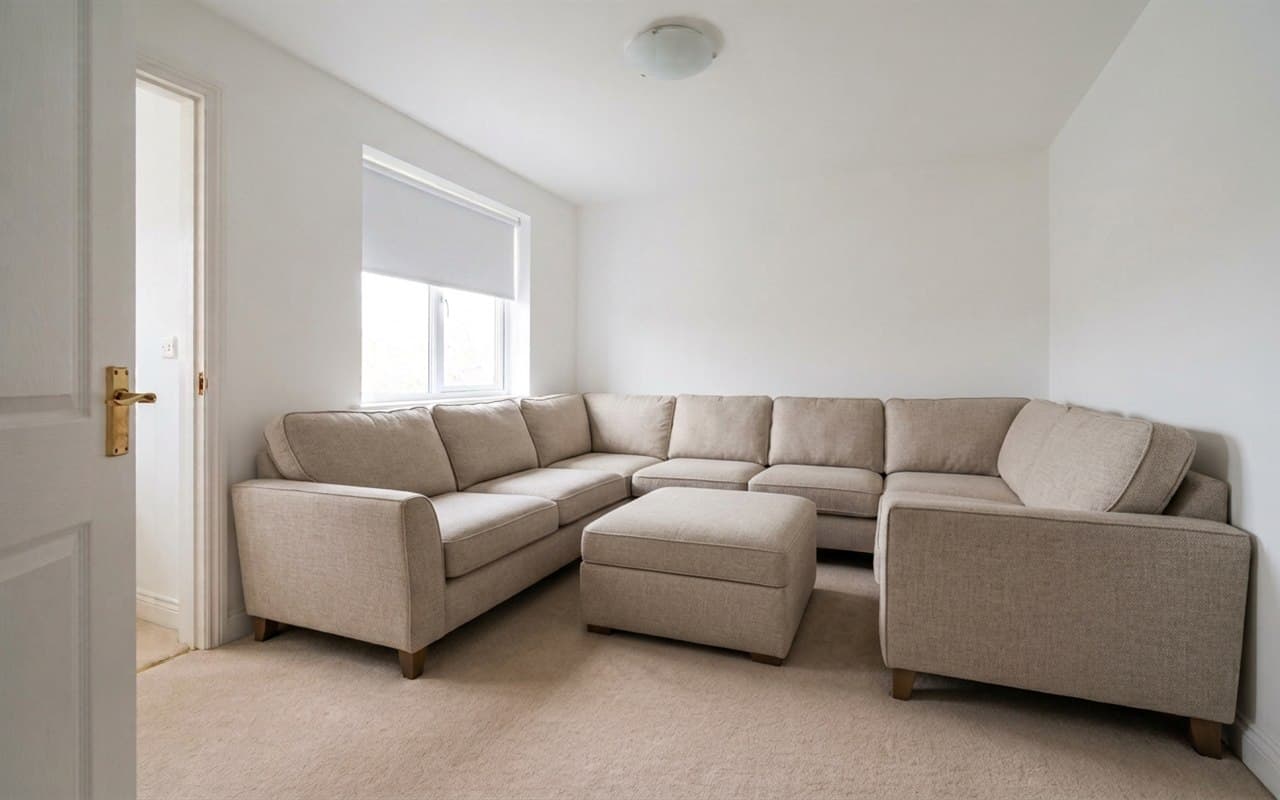
| Furnishing an empty room | Adds no element of the property and removes none, so on the face of the statute it is the arguable case. The association that advanced the bill does not treat it as arguable: virtual staging is fine, so long as buyers know it is virtual. Wisconsin REALTORS Association, “Promoting Transparency and Consumer Confidence” |
| Painting out a neighboring structure | Named by the association that advanced the bill as an example of an edit that creates a false impression of the property’s true condition. It is the clearest case there is on the disclosable side of the line. Wisconsin REALTORS Association, “Promoting Transparency and Consumer Confidence” |
| Adding landscaping, or greening what is already there | The other example they named. The property is unchanged; what the photograph says about the state it is in is not, and the statute is written about the impression rather than the structure. Wisconsin REALTORS Association, “Promoting Transparency and Consumer Confidence” |
| Removing a support post, a radiator or an electrical panel | Removes an element of the property and misstates what a buyer would find in the room. Disclosure is the floor here, not the ceiling: section 452.136 (1) separately bars advertising that is false, deceptive or misleading, and a label under an image does not make the image true. Wis. Stat. 452.136 (advertising by licensees) |
| Decluttering: taking out the seller’s own furniture | Removes nothing that conveys with the property and normally leaves no false impression. The exception is what the clutter was standing in front of, because removing a wardrobe that hid a damp patch changes the impression and not the furniture. Wis. Stat. 452.136 (1m) (advertising enhanced by technology) |
| Exposure, white balance, straightening a vertical | Adds, removes and changes nothing, so the trigger is never reached. Wisconsin needed no written exemption for this, which is why it has none: the threshold does the work California’s carve out does. Wis. Stat. 452.136 (1m) (advertising enhanced by technology) |
| A generated walkthrough video or virtual tour | The statute says advertising, not images, so a tour is inside it. A camera move that never happened adds no element of the property, but a tour that invents a doorway, a sightline or a room’s proportions does, and that is where a buyer’s sense of the layout comes from. Wis. Stat. 452.136 (1m) (advertising enhanced by technology) |
 AI-generated
Wisconsin and California asked the same question and wrote opposite answers
AB 723 is a mechanics statute. It requires a reasonably conspicuous statement on or adjacent to a digitally altered image, and it requires the unaltered original to be reachable from that same spot, posted or linked or behind a QR code. It defines the edits it covers, writes lighting, sharpening, white balance and color correction out of the definition, and never asks whether the edit misled anyone. AB 723 bill text, California Legislature
Section 452.136 (1m) is the other half of the problem and none of the same half. It names no wording, no position, no file to keep and no exemption. What it adds is the question California left out, and what it leaves out is every instruction California put in. Wis. Stat. 452.136 (1m) (advertising enhanced by technology)
For a brokerage working in both states, that asymmetry settles the operating question. A photograph prepared to the California rule, labeled on the image with the original alongside it, satisfies Wisconsin as well, because a disclosure that is conspicuous on the image is a disclosure. The reverse does not hold: a Wisconsin compliant listing can carry a line of text and no original at all.
There are two places Wisconsin reaches further. AB 723 is written for advertising “for the sale of real property”, while section 452.136 (1m) says all advertising by a licensee, which takes in property offered for lease. And AB 723 is written about an image, while Wisconsin’s subsection is written about the advertising, which is why a generated tour is a harder thing to argue out of the Wisconsin rule than out of the California one. AB 723 bill text, California Legislature
California, since 1 January 2026
Label it, and publish the original
A reasonably conspicuous statement on or adjacent to the image, plus the unaltered original reachable from the same place. It applies to any added, removed or changed physical element, with ordinary photographic adjustment written out of the definition, and asks nobody to judge whether the edit misleads.
Wisconsin, from 1 January 2027
Say it, when the edit misleads
Disclosure in all advertising and nothing further: no wording, no position, no original, no list of exempt edits. What it adds instead is a threshold, and the licensee who made the edit is the one who applies it.
Wis. Stat. 452.136 (1m) (advertising enhanced by technology)
 AI-generated
What it costs to get wrong
No dollar figure appears anywhere in section 452.136, which is worth saying plainly, because figures attach themselves to laws like this one within weeks of enactment. The exposure comes from three sections that were already there.
Chapter 452 carries a catch all penalty. Section 452.17 (3): “Any person who otherwise violates any provision of this chapter may be fined not more than $5,000 or imprisoned for not more than 6 months or both.” An undisclosed edit is a violation of a provision of the chapter, and nothing in the new subsection displaces that. Wis. Stat. 452.17 (3) (penalties)
The route a complaint actually travels is the board. Under section 452.14 (3) the Real Estate Examining Board may revoke, suspend or limit a license, or reprimand the licensee, on any of a list of grounds, and paragraph (L) is simply having “violated any provision of this chapter or any rule promulgated under this chapter.” Paragraph (d), a continued and flagrant course of misrepresentation through advertising, is the one that fits a whole portfolio of listings rather than a single photograph. Wis. Stat. 452.14 (3) (grounds for discipline)
Money is available to the board too. Section 452.14 (4m) (a) lets it assess a forfeiture of up to $5,000 for each violation, in addition to or in place of a reprimand, limitation, suspension or revocation. Per violation, in a business where one listing carries twenty photographs, is the phrase to sit with. Wis. Stat. 452.14 (4m) (forfeitures the board may assess)
The buyer has a route of their own, and it predates all of this. Section 100.18 makes an untrue, deceptive or misleading representation to the public actionable, and a person who lost money because of one may sue for that loss. The subsection carries a carve out most summaries miss: no attorney fees may be recovered from a person licensed under chapter 452 while engaged in real estate practice. The loss is recoverable; the lawyer is not. Wis. Stat. 100.18 (11) (b) 2. (private action for a misleading advertisement)
And the clock is short. Section 452.142 (1) requires an action concerning a licensee’s acts or omissions in brokerage services to be commenced within two years, notwithstanding the longer periods that would otherwise apply, which includes the one in section 100.18 itself. Wis. Stat. 452.142 (1) (two year limitation on actions against licensees)
Prosecution
$5,000 or 6 months, or both
Section 452.17 (3), the chapter’s catch all penalty for a violation with no penalty of its own, which is what an undisclosed edit is. No figure of any kind appears in section 452.136.
The board
The license, plus up to $5,000 for each violation
Section 452.14 (3) puts a license at risk for violating any provision of the chapter, and 452.14 (4m) (a) adds a forfeiture of up to $5,000 per violation on top of, or instead of, the discipline.
The buyer
Their loss, but not their lawyer
Section 100.18 lets a buyer who lost money on a misleading advertisement recover that loss, while expressly denying attorney fees against a chapter 452 licensee in practice. Section 452.142 (1) gives them two years to start.
Wis. Stat. 100.18 (11) (b) 2. (private action for a misleading advertisement)
The rest of Act 69 arrives on the same morning
The reason the trade press is reading Act 69 at all is money. Section 452.19 (3) bars a firm from accepting compensation of any kind from another firm on a one to four unit residential transaction, referral and finder’s fees aside, and makes any agreement that does so void and unenforceable. That is the headline, and the photograph sentence has been traveling in its shadow. Wis. Stat. 452.19 (3) (firm to firm compensation)
The other new duty matters more to a photographer. From the same date, a listing firm has one business day from the start of the agency agreement to advertise the property on an internet platform accessible to the general public, unless the owner completes and signs an opt out form prescribed by the department, initialing an acknowledgment that a private listing may cost them offers, exposure and price. Wis. Stat. 452.1355 (transactions involving residential property)
Put the two new sections next to each other and the shape of the day is clear. More Wisconsin listings will be public, faster, and every one of them arrives under a duty to admit what its pictures have had done to them. A photographer with a next day turnaround now has a client with a one business day deadline.
The half being reported
No firm to firm compensation
Section 452.19 (3) bars a firm from accepting compensation of any kind from another firm on a one to four unit residential transaction, referral and finder’s fees aside, and makes an agreement that does so void and unenforceable. This is what the trade press means by Act 69.
The half a photographer feels
Public within one business day
Section 452.1355 gives a listing firm one business day from the start of the agency agreement to advertise the property somewhere the general public can see it, unless the owner signs the department’s opt out form. More listings, sooner, each one already carrying the new duty.
Wis. Stat. 452.1355 (transactions involving residential property)
What the board and the association have said so far
The Real Estate Examining Board started the rulemaking in February 2026, asking department staff to draft a scope statement on Act 69 covering chapters REEB 15, 16, 24 and 25. The proposed scope came back to the board’s April 2026 meeting under the title “Marketing, Advertising, and Compensation”, adding REEB 11, and describing its objective as updating the administrative code “in line with 2025 Wisconsin Act 69.” Real Estate Examining Board, 23 April 2026 meeting materials
The board has the authority to be specific if it wants to be. Section 452.07 (3): “The board may promulgate rules regarding advertising by brokers or salespersons that do not conflict with s. 452.136.” As of September 2026 it has not used it on this subject. No wording has been prescribed, no placement, and nothing on whether the original has to be kept. Wis. Stat. 452.07 (3) (the board’s rulemaking power over advertising)
What the board did authorize at the same meeting is instructive about where the attention is going: a forms council review of eighteen WB forms in light of Act 69, and a draft consumer brochure about the benefits of public marketing. Both belong to the opt out, not to the photographs. Real Estate Examining Board, 23 April 2026 meeting materials
The Wisconsin REALTORS Association, which advanced the bill, set out its own reading while it was still a bill, and as of September 2026 it is still the most specific published guidance on this subsection. It names two examples, “digitally removing a neighboring structure or adding lush landscaping”, tells members to review “photos, renderings and virtual tours” for material alterations, and puts the staging question to bed in one line: “Virtual staging is fine, so long as buyers know it’s virtual.” Wisconsin REALTORS Association, “Promoting Transparency and Consumer Confidence”
So a Wisconsin licensee writing a disclosure line in 2026 is writing it themselves. That is not a reason to wait for the board. A line that names what was changed, sits where the buyer is looking and goes out with the listing satisfies the statute on any reading of it, and it is the same line California would have required anyway.
New York is drafting the version that names video
New York Senate Bill S9584, introduced by Senator Rachel May, would amend the general business law and the real property law to designate materially misleading digital representations in real estate listings as a deceptive act and as false advertising, with license suspension or revocation attached. It was reported out of consumer protection and committed to the judiciary committee on April 28, 2026, and had not passed as of September 2026. New York Senate Bill S9584
Its drafting is worth watching for one reason. Where California legislated about an image and Wisconsin about advertising, New York defines its subject as images, videos and virtual tours together, which is the first time the three have been named side by side in a bill of this kind. Wisconsin reaches the same place with a broader word; New York proposes to reach it with a list. New York Senate Bill S9584
California, in force
An image
AB 723 is written about a digitally altered image used in an advertisement for the sale of real property. It is the narrowest subject of the three and the only one that arrives with mechanics attached.
Wisconsin, from 2027
All advertising
Section 452.136 (1m) names no medium at all. One word carries the video, the rendering and the floor plan into the duty without any of them being listed, and without anybody having to argue that a tour is an image.
Wis. Stat. 452.136 (1m) (advertising enhanced by technology)
New York, still a bill
Images, videos and virtual tours
S9584 names the three side by side and treats a materially misleading one as a deceptive act and as false advertising, with suspension or revocation of the license available. Committed to judiciary on April 28, 2026 and not passed as of September 2026.
Before 1 January 2027
- Sort your edits into the two piles the statute cares about: edits that change an element of the property, and edits that change the exposure. Only the first pile can ever reach the threshold. Wis. Stat. 452.136 (1m) (advertising enhanced by technology)
- Write the sentence now and use the same one every time. The statute prescribes no wording and the board has prescribed none either, so the only thing that can be wrong with your line is that a buyer did not see it. Wis. Stat. 452.07 (3) (the board’s rulemaking power over advertising)
- Apply it past photographs. The duty is written about advertising, so a generated tour, a rendering and a floor plan with a wall moved are inside it, whatever the board’s own summary says about images. Wis. Stat. 452.136 (1m) (advertising enhanced by technology)
- Do not rely on the one to four unit limit. It belongs to the marketing and compensation sections of Act 69, not to section 452.136 (1m), which says all advertising by a licensee and names no property type. 2025 Wisconsin Act 69, enrolled text
- Do not rely on the good faith safe harbor either. Section 452.1355 (2) protects the sharing, answering, showing and public marketing duties, and says nothing about an advertising disclosure. Wis. Stat. 452.1355 (2) (the good faith safe harbor)
- Keep the unaltered original even though Wisconsin never asks for it. California requires it, an MLS may require it, and when the question is whether an edit misled someone, it is the only document that answers. AB 723 bill text, California Legislature
- Brief whoever uploads. A licensee associated with a firm advertises under the supervision of and in the name of the firm, so an unlabeled staged photo is the firm’s problem before it is the assistant’s. Wis. Stat. 452.136 (advertising by licensees)
- Count your listings against the calendar. From the same date a property has to be publicly advertised within one business day of the listing agreement unless the owner signs the opt out form, which leaves less time to decide what to disclose than most agents have now. Wis. Stat. 452.1355 (transactions involving residential property)
Read next
The rest of the series
California AB 723: what virtual staging disclosure actually requires
The first state to legislate, and the one that wrote the mechanics: what the label has to say, where the unaltered original has to sit, and which circulating penalty figures are not real.
What UK agents must disclose when a listing photo is digitally altered
The same question with no property statute behind it, where a general prohibition on unfair commercial practices has to be applied to a photograph, and a disclosure printed in white on white failed the test.
Why AI-staged listing photos look fake, and what buyers actually notice
What a buyer sees before they read any disclosure. Wisconsin wrote its threshold around a false impression, and the impression forms in the first second of looking.
Questions
Common questions
Does Wisconsin require disclosure of AI-edited listing photos?
From January 1, 2027, yes. Section 452.136 (1m), created by 2025 Wisconsin Act 69, requires a licensee to disclose in all advertising that it was altered or modified using technology, including artificial intelligence, to add, remove or change elements of the property in a way that creates a false or misleading impression of it.
Wis. Stat. 452.136 (1m) (advertising enhanced by technology)When does Wisconsin Act 69 take effect?
January 1, 2027, for the whole act. It was enacted on December 9, 2025 and published on December 10, 2025, and its final section sets that single date.
2025 Wisconsin Act 69, enrolled textDoes the Wisconsin AI disclosure apply only to one to four unit residential property?
No. That limit belongs to the public marketing duty and the compensation provisions of Act 69. Section 452.136 (1m) says “a licensee” and “all advertising”, names no property type, and so reaches commercial listings, land and property offered for lease as well.
Wis. Stat. 452.136 (1m) (advertising enhanced by technology)Does Wisconsin require the unaltered original photo the way California does?
No. California’s AB 723 requires the unaltered original to be reachable from the same place as the disclosure. Wisconsin requires the disclosure and stops there, with no wording, no placement rule and no original. Keeping the original is still the only way to answer a question about what was changed.
AB 723 bill text, California LegislatureDoes the Wisconsin rule cover video and virtual tours?
The text says advertising rather than images, so a video or a virtual tour sits inside it. The Real Estate Examining Board’s own scope statement describes the provision as being about images, which is narrower than the statute it is summarizing, and no rule has been promulgated to settle the point.
Real Estate Examining Board, 23 April 2026 meeting materialsWhat is the penalty for an undisclosed AI-altered listing photo in Wisconsin?
Section 452.136 sets none. Chapter 452 supplies them: a fine of up to $5,000 or six months, or both, under section 452.17 (3), and separately the Real Estate Examining Board may revoke, suspend or limit a license or reprimand the licensee, with a forfeiture of up to $5,000 for each violation available on top.
Wis. Stat. 452.17 (3) (penalties)Miravely changes furniture, surfaces and planting while wall junctions, window openings and door positions stay where the camera found them, and the photograph you uploaded stays in your account beside the result, which is the file every argument about a false impression ends up asking for.